
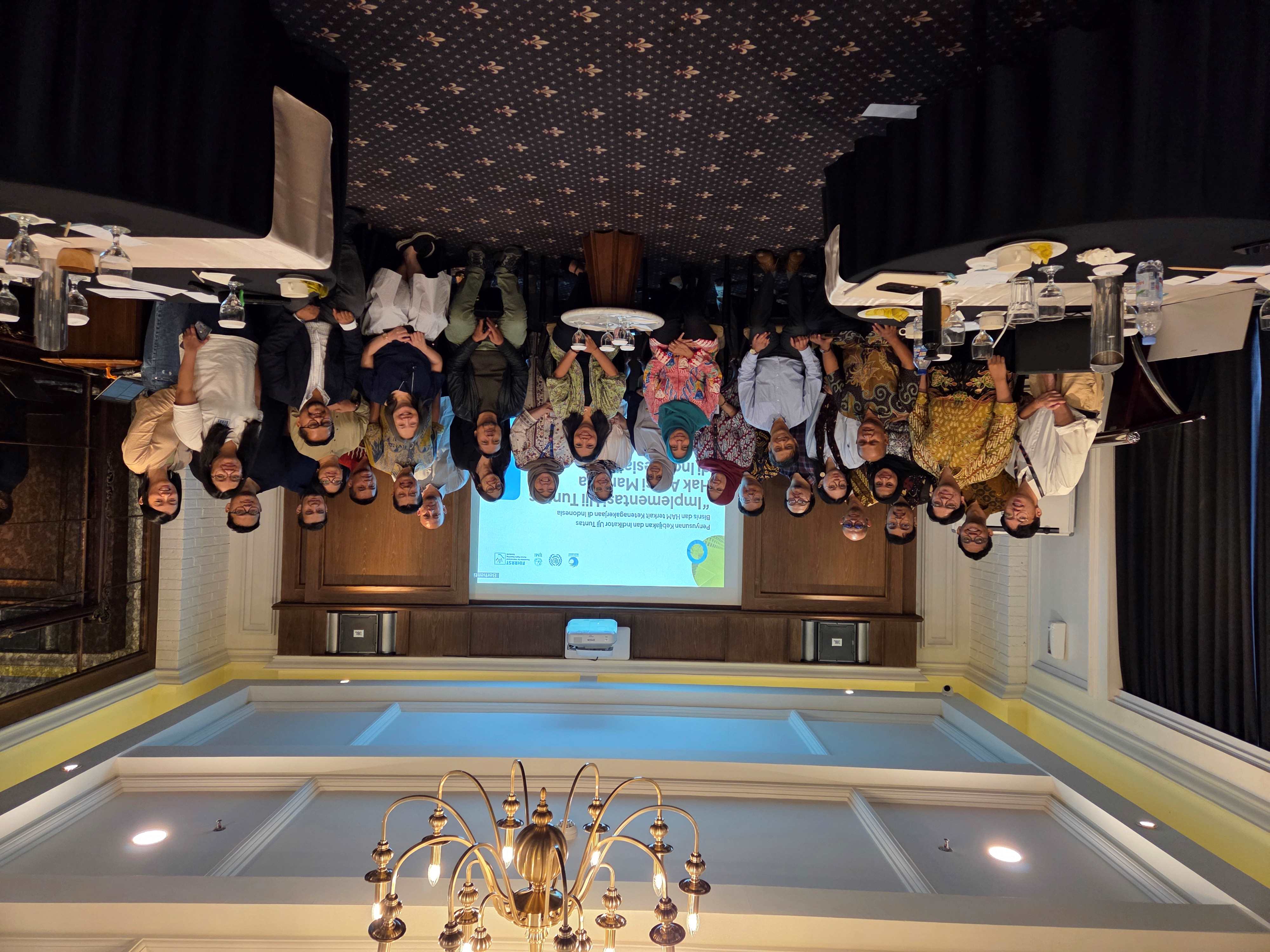
A two-day workshop in Bogor brought together government, businesses, and civil society representatives to develop collaborative policies and indicators.
Bogor, 28–29 August 2025 – A workshop for Developing Policies and Indicators of Business and Human Rights (BHR) Due Diligence in Indonesia, organized by FIHRRST, IJMI, the International Labour Organization (ILO), and the Ministry of Law and Human Rights, was held over two days to discuss proposed indicators for Human Rights Due Diligence (HRDD) in Indonesia.
The workshop was attended by diverse stakeholders ranging from the Ministry of Empowerment, and Bappenas, corporations (BUMI, APP, RAPP, and PT Panasonic, and CSOs (Infid, HRWG, IGCN), business organization (Apindo, Kadin), academia, and UNICEF.
Throughout the workshop, a series of presentations were delivered by experts. Hi Do Quynh presented global HRDD regulations and their implications for businesses. Lany Harijanti, ILO Consultant, explained the objectives and processes of HRDD in practice. Tauvik Muhamad, ILO RISSC Project Coordinator, shared Fundamental Principles and Rights at Work along with the ILO MNE Declaration. FIHRRST’s Ratih Ananda Putri shared good practices on HRDD implementation and introduced proposed forced labor indicators (idBHR), offering practical insights to strengthen labor rights compliance in Indonesia.
After the expert presentations, the agenda continued with a panel session titled, “Creating a Dignified Workplace: Synergy between Human Rights Indicators and Labor Regulations”, which brought together key stakeholders. Sofia Alatas, Director of Human Rights Instrument Development and Evaluation at the Ministry of Law and Human Rights, presented on the draft Presidential Regulation on Business and Human Rights and PRISMA. Bagus Kuncoro, from the Ministry of Manpower, addressed labor norms supervision, while APINDO’s Myra Hanartani outlined proposed indicators on fundamental workplace rights from ILO–APINDO discussions. Dios Lumban Gaol from SBMI then offered a worker’s perspective on business and human rights. Moderated by Nety Tarigan from IJMI, the panel underscored that responsibility rested with those who acted; PRISMA should be updated as a key instrument; collaboration was vital in shaping obligations, and accountability across Indonesia’s industries should not be separated from their supply chains.
On the second day, the workshop continued with group discussions facilitated by Unang Mulkhan from FIHRRST, who opened the session by outlining its purpose to gather input and proposals on indicators and key elements of HRDD related to fundamental rights at work. Participants reviewed the draft of Scope 1 through five thematic groups and discussed issues such as the elimination of forced labor, discrimination and workplace violence, freedom of association and collective bargaining, and occupational safety and health. Each group later presented its draft proposals for HRDD indicators.
The workshop concluded with a closing statement by Sofia Alatas, who expressed gratitude for the attendees’ participation in the collaborative process. She emphasized that all ideas and recommendations would be consolidated and followed up, with a target to finalize the indicators in 2025. Her remarks reflected the broader goal of the workshop to strengthen Indonesia’s commitment to protecting and fulfilling human rights in the business sector.