
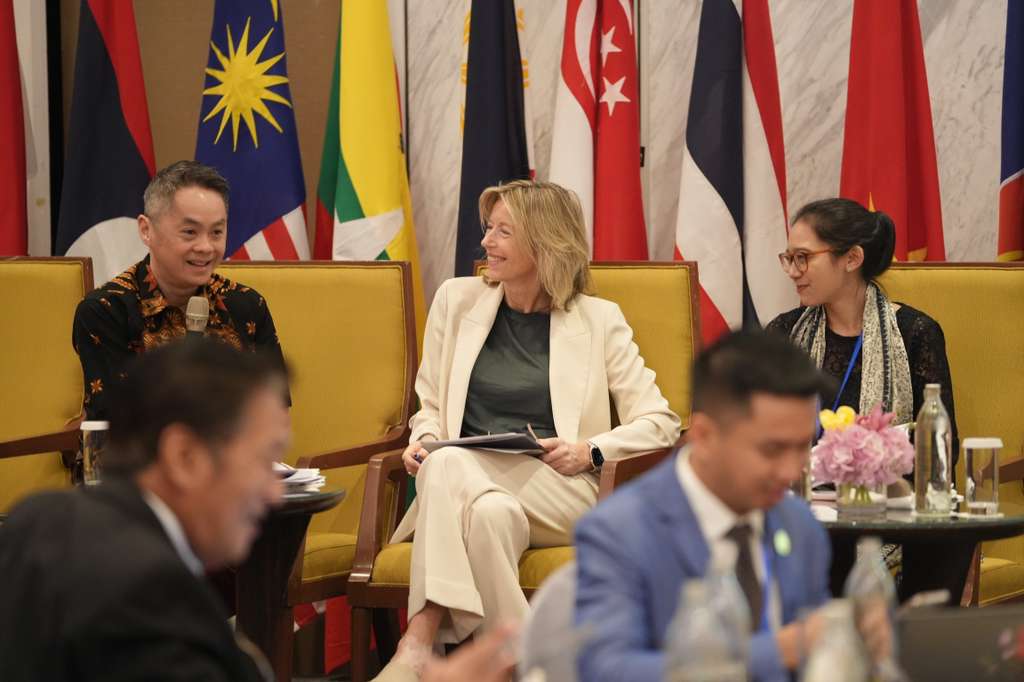
Kuala Lumpur, Malaysia, 16 October 2025 – The Foundation for International Human Rights Reporting Standards (FIHRRST) took part in the ASEAN–EU Dialogue on Intensifying Actions, Overcoming Barriers in Implementing Business and Human Rights and Environment in ASEAN and the EU, held earlier this month. Representing FIHRRST, Ratih Ananda Putri, Program Coordinator and Senior Business and Human Rights Specialist, spoke during Session 1: High-Level Overview – Progress and Challenges in Implementing Business and Human Rights in ASEAN and the EU, moderated by H.E. Edmund Bon Tai Soon, Chair of AICHR and Representative of Malaysia to AICHR.
The session featured several prominent figures, including H.E. Kajsa Ollongren, EU Special Representative for Human Rights; and Nareeluc Pairchaiyapoom from Thailand’s Ministry of Justice. The dialogue served as a platform for ASEAN and EU representatives to exchange views on advancing business and human rights (BHR) frameworks and to identify opportunities for stronger collaboration between the two regions.
In her presentation, Ratih noted that ASEAN has made remarkable progress in integrating business and human rights (BHR) principles, yet translating commitments into practical action remains a complex and evolving journey. As the region enters the second decade of implementation in 2025, governments, multinational enterprises, and civil society are increasingly advocating for mandatory human rights due diligence, stronger regulatory obligations, and more effective remedy mechanisms. However, persistent challenges such as fragmented regulations, limited enforcement, and balancing competitiveness with rights compliance continue to shape the regional landscape.
She explained that ASEAN countries including Thailand, Indonesia, Vietnam, and Malaysia have demonstrated growing political determination to promote responsible business conduct under the UN Guiding Principles on Business and Human Rights (UNGPs). Despite this, recurring issues remain, among them poor working conditions, low wages, child labor, unfair land acquisition, gender inequality, and environmental degradation.
Ratih outlined three main factors driving progress in the region. First, the private sector’s growing commitment to Environmental, Social, and Governance (ESG) principles has become a positive force, creating a bridge between responsible business practices and human rights. This development is supported by stronger collaboration among governments, companies, and civil society, as well as active discussions through ASEAN and its partners. However, she noted that many countries still face challenges in ensuring consistent policies, raising business awareness, and building the capacity needed for effective enforcement.
Ratih underscored that a growing number of businesses now recognize that respecting human rights goes beyond regulatory compliance, it is a strategic investment in sustainable and responsible growth. This awareness, she noted, is increasingly reflected in corporate sustainability reporting and long-term business planning. She concluded, “ASEAN’s journey in implementing Business and Human Rights is well underway, yet it remains a work in progress. The challenges we face, from capacity and coordination to awareness and enforcement, should not be seen as setbacks, but as opportunities to strengthen collaboration, drive innovation, and build a culture of shared learning across the region.”